-

-

+86-0576-86655111
-

Wenling , Zhejiang, China
+86-0576-86655111
Wenling , Zhejiang, China

Industry News
 Home / News / Industry News / Could a Smarter Battery Pipe Plumbing Tool Make Difficult Installations Easier?
  2026.09.11
 Industry News
For plumbing contractors, the move toward cordless equipment is changing how pipe connections are handled on renovation sites, commercial projects, and maintenance jobs. Modern press tools increasingly combine battery power with compact designs, rotating heads, automatic cycle control, and electronic monitoring. For buyers evaluating a Battery Pipe Plumbing Tool, the real question is not simply how powerful the motor is, but whether the tool can deliver consistent connections while remaining practical in confined and demanding work environments.
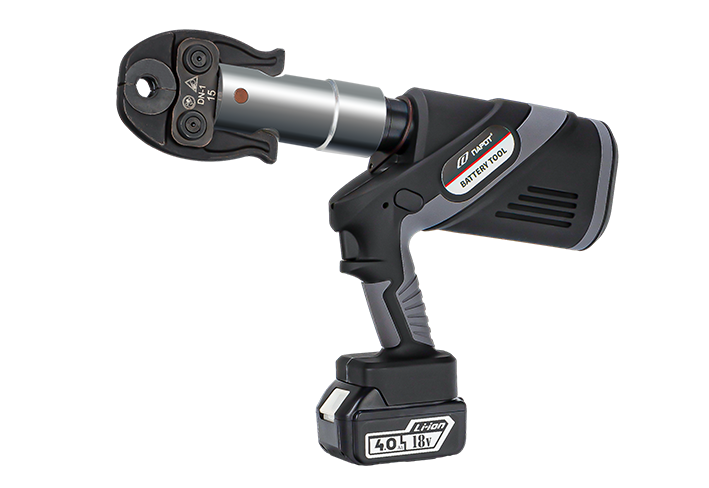
A cordless tool should be matched to the pipe and fitting system it will actually handle. Copper, stainless steel, PEX, multilayer pipe, and other systems can require different jaws, rings, and pressing profiles. Current professional tools commonly support interchangeable accessories, but compatibility remains system-dependent.
Before purchasing, contractors and distributors should verify:
This prevents a common purchasing mistake: selecting a tool with broad-looking specifications but limited compatibility for the actual project.
Pipe installation rarely happens in an ideal position. Installers may work behind cabinets, inside service shafts, beneath ceilings, or close to existing pipework. In these situations, tool geometry can be as important as pressing force.
Modern cordless press tools increasingly use rotating or swiveling heads to improve access. For example, current professional models offer head rotation designed to help operators position the jaws around installed pipework. A well-designed cordless pipe press tool should therefore allow sufficient movement without making the operator reposition the entire tool repeatedly.
A completed connection is only useful when the pressing cycle is performed correctly. Battery-powered tools are now incorporating features such as automatic cycling, pressure monitoring, battery checks, and visual or audible completion indicators.
From a manufacturing perspective, these functions address a practical problem: reducing variation between operators. A tool that can confirm whether the required cycle has been completed provides an additional layer of process control, particularly for contractors handling large numbers of connections.
Tool weight is easy to compare on a specification sheet, but balance determines how that weight feels during installation. Repeated overhead work can place additional demands on the operator, especially when the tool must be held in position before and during the pressing cycle.
Current compact models increasingly use inline configurations, forward-positioned controls, and balanced housings to improve access and one-handed operation. For procurement teams, evaluating ergonomics alongside output specifications can help identify equipment that is more practical for repeated daily use.
Battery performance is not simply a matter of selecting the largest battery available. Contractors also need to consider charging arrangements, spare-battery requirements, operating temperature, and whether the battery belongs to an established tool platform.
Some professional tools include pre-press battery checks to prevent a cycle from starting when available power may be insufficient. For distributors and OEM buyers, battery compatibility should therefore be considered together with the charger, electronics, motor, hydraulic system, and service requirements.
Long-term value also depends on what happens after the tool leaves the factory. Press tools are precision equipment, so calibration, inspection, replacement jaws, service intervals, and diagnostic functions should be considered during product development.
Some current systems provide cycle records, calibration information, service history, or digital reporting capabilities. These functions can help contractors document tool usage and support more structured maintenance programs, particularly on projects where installation records matter.
For manufacturers developing or sourcing cordless plumbing equipment, the useful specification begins with the application rather than a list of isolated features. Motor output, battery voltage, pressing force, cycle control, jaw compatibility, head movement, ergonomics, diagnostics, and serviceability should be evaluated as one system.
The continued development of cordless press technology shows that contractors are looking for more than portability. They need dependable connection control, practical access, manageable handling, and equipment that fits their existing workflow. A properly engineered Battery Pipe Plumbing Tool can bring these requirements together, giving OEM brands, distributors, and professional installers a more practical solution for modern pipe installation.
Recommended Products
Copyright © Taizhou Naibo Machinery Co., Ltd. All Rights Reserved.

Cable Wire Cutting Tool Manufacturer
 English
 Español
 русский
 Français
 Deutsch
 Português