-

-

+86-0576-86655111
-

Wenling , Zhejiang, China
+86-0576-86655111
Wenling , Zhejiang, China

Industry News
 Home / News / Industry News / How Can a Battery Pipe Plumbing Tool Improve Productivity in Tight Installation Spaces?
  2026.09.18
 Industry News
As plumbing contractors take on more renovation, retrofit, and maintenance work, access limitations are becoming an important factor in tool selection. Cordless press technology is increasingly designed around compact bodies, one-handed operation, rotating heads, automatic cycles, and battery-powered mobility. For contractors and distributors, a Battery Pipe Plumbing Tool should therefore be evaluated not only for pressing capability, but also for how effectively it handles restricted spaces, repeated connections, and changing jobsite conditions.
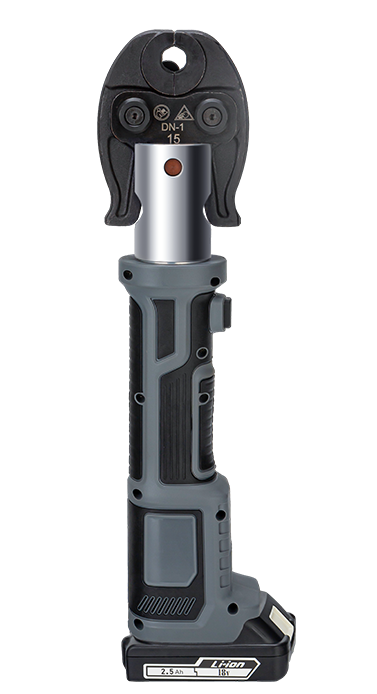
A tool may provide sufficient pressing force yet remain difficult to use when pipework is installed close to walls, ceilings, cabinets, or existing services. This is particularly common during retrofit projects, where installers must work around infrastructure that cannot easily be removed.
Inline designs and rotating heads are becoming practical solutions. Current professional press tools use compact configurations and swivel mechanisms to help installers position jaws around existing pipework. For manufacturers, this highlights an important design principle: the mechanical system should be developed around real installation access rather than laboratory performance alone.
When an installer is working above a ceiling or inside a narrow service area, using both hands to position a tool can be inconvenient. A balanced housing, forward trigger position, and easy-opening jaw can make the connection process easier to control.
Some current cordless press tools specifically emphasize one-handed operation and inline balance. These design choices are relevant to OEM buyers because ergonomics can influence how easily a tool is adopted across different installation teams. A compact structure is especially useful when the same equipment needs to serve both workshop fabrication and on-site repair work.
A professional plumbing tool should make it easier for operators to complete the required pressing sequence correctly. Modern systems increasingly include automatic cycle functions, battery checks, LED indicators, and electronic monitoring. These features are intended to reduce the possibility of starting a cycle that cannot be completed or leaving an operator uncertain about the connection status.
For buyers comparing cordless pipe pressing equipment, useful questions include:
These details can be more meaningful than motor specifications alone.
Battery capacity has to be considered alongside tool size, operating frequency, and charging arrangements. A larger battery may provide additional operating time, but it can also influence overall tool weight and handling.
Current professional models use different battery platforms according to their intended application. For example, RIDGID offers compact 12V press equipment, while other professional systems use larger battery platforms for broader applications. Procurement teams should therefore assess the complete power system, including battery availability, charger compatibility, spare-battery planning, and replacement support.
The tool body is only one part of a pipe pressing system. Jaws, rings, adapters, and fitting profiles determine whether the equipment can actually be used across a contractor's project portfolio.
Current press-tool manufacturers provide different jaw configurations for copper, stainless steel, PEX, multilayer pipe, and other systems. Before placing an OEM or wholesale order, buyers should verify pipe diameter ranges, fitting profiles, accessory availability, and whether additional jaws can be supplied as project requirements change.
Professional plumbing tools are repeatedly exposed to dust, vibration, temperature changes, and demanding handling. A suitable design should therefore consider more than initial performance. Motor durability, hydraulic or mechanical transmission design, battery protection, jaw locking, housing construction, and service accessibility all contribute to long-term usability.
Diagnostics can also help maintenance teams identify conditions such as low battery, excessive temperature, or required service. For distributors and engineering buyers, these functions can make product support more structured and reduce uncertainty during field operation.
There is no single specification that determines whether a cordless plumbing tool is appropriate. Contractors should evaluate the entire working process: pipe material, connection size, installation environment, access limitations, pressing frequency, battery strategy, accessory range, and service requirements.
As manufacturers continue refining cordless press technology, the emphasis is shifting toward practical jobsite performance rather than power alone. For distributors, OEM brands, and professional installers, selecting a Battery Pipe Plumbing Tool that combines controlled pressing, compact access, ergonomic handling, compatible accessories, and dependable battery operation can provide a more practical solution for modern pipe installation.
Recommended Products
Copyright © Taizhou Naibo Machinery Co., Ltd. All Rights Reserved.

Cable Wire Cutting Tool Manufacturer
 English
 Español
 русский
 Français
 Deutsch
 Português