-

-

+86-0576-86655111
-

Wenling , Zhejiang, China
+86-0576-86655111
Wenling , Zhejiang, China

Industry News
 Home / News / Industry News / How Can Contractors Choose the Right Battery Pipe Plumbing Tool for Confined Jobsites?
  2026.09.25
 Industry News
As plumbing contractors take on more retrofit, maintenance, and renovation projects, working conditions are becoming less predictable. Installers may need to make pipe connections inside cabinets, service shafts, ceiling spaces, or around existing infrastructure where access to mains power is limited. This has increased interest in cordless equipment that combines mobility with controlled operation. For professional users, choosing a Battery Pipe Plumbing Tool is not simply about battery capacity or motor output; the more important question is whether the tool matches the pipe system, working environment, connection method, and daily workload.
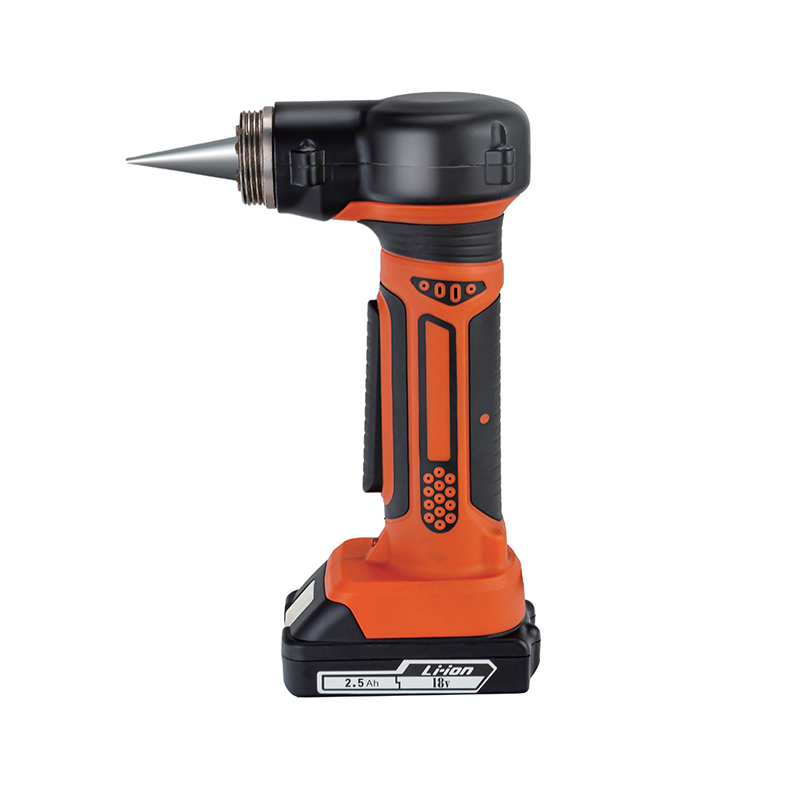
A tool that performs well in an open workshop may be difficult to use in a restricted installation area. Limited clearance can prevent the operator from positioning the jaws correctly, while overhead work can make a heavy or poorly balanced tool uncomfortable to handle.
For this reason, compact housing, balanced weight distribution, and a movable or rotating press head deserve attention during procurement. A practical cordless pipe tool should allow installers to approach fittings from different angles without repeatedly repositioning the entire tool. This can be particularly useful when repairing existing plumbing systems where surrounding components cannot easily be removed.
Battery specifications should be evaluated according to the actual working pattern rather than viewed as an isolated number. A higher-capacity battery may provide longer operating time, but it can also increase the overall weight of the equipment.
For contractors and distributors, the complete power system should be considered, including battery availability, charging time, spare-battery planning, charger compatibility, and electronic protection. For frequent field work, a balanced battery solution can be more practical than simply choosing the largest available capacity.
Connection quality depends on more than mechanical force. The pressing cycle needs to be completed correctly and consistently, particularly when different installers are using the same equipment.
Modern battery-powered plumbing tools can incorporate automatic cycling, battery-status monitoring, completion indicators, and other control functions. These features can provide clearer feedback during installation and reduce uncertainty about whether a pressing operation has been completed properly.
For project buyers, this makes cycle control an important specification to review alongside pressing force and operating speed.
A professional pipe pressing tool is only useful when its accessories match the selected fitting system. Different pipe materials, diameters, and connection profiles may require specific jaws or press rings.
Before placing an order, procurement teams should confirm:
This is particularly important for distributors and OEM buyers serving several markets. A clearly defined accessory system can make one tool platform suitable for a broader range of professional applications.
Portability has become an important consideration as contractors move between different jobsites. A compact tool can be easier to transport, store, and position, but compactness should not come at the expense of structural reliability or operating control.
From a manufacturer's perspective, the design process needs to balance housing size, drive-system layout, battery position, pressing mechanism, heat management, and operator ergonomics. The objective is not simply to make a smaller tool, but to create equipment that remains practical when used repeatedly in real installation conditions.
Distributors and engineering buyers should assess the complete product system before selecting a cordless plumbing tool. Product documentation should clearly identify application ranges, compatible accessories, operating procedures, battery requirements, maintenance provisions, and available replacement components.
It is also useful to evaluate whether the manufacturer can support OEM requirements, packaging customization, accessory configurations, technical documentation, and after-sales service. These factors can influence the long-term value of the product just as much as its initial specification.
At the manufacturing stage, we believe a professional cordless plumbing tool should be developed around actual installation requirements rather than a collection of headline specifications. Pipe compatibility, working access, pressing control, battery strategy, ergonomics, accessory availability, and serviceability need to work together as one system.
As retrofit and mobile plumbing work continue to create demand for flexible equipment, contractors need tools that can move easily between jobsites while maintaining predictable operation. For distributors, OEM buyers, and professional installers, selecting the right Battery Pipe Plumbing Tool means looking beyond power alone and evaluating how effectively the complete tool system fits the realities of modern pipe installation.
Recommended Products
Copyright © Taizhou Naibo Machinery Co., Ltd. All Rights Reserved.

Cable Wire Cutting Tool Manufacturer
 English
 Español
 русский
 Français
 Deutsch
 Português